What a gambling licence actually costs in 2026: application fees, annual fees and gaming tax compared

# The assumptions
The example is a B2C online casino with 2,000,000 of gross gaming revenue a year (stakes less winnings), counted in each jurisdiction’s own currency to avoid exchange-rate noise. Only charges payable for the licence (to the regulator or the treasury) and gaming tax are included. Corporate tax, staff, audits, testing labs, banking and the cost of locked-up capital are left out and are covered separately below.
# Regulator charges and gaming tax at 2 million of revenue
| Jurisdiction | Year one | Each later year | What drives the number |
|---|---|---|---|
| Curaçao (CGA) | EUR 52,042 | EUR 47,450 | EUR 4,592 application (plus EUR 150 per beneficial owner), then a flat EUR 47,450 a year: EUR 22,960 to the regulator and EUR 24,490 to the treasury. The gaming law sets no tax on revenue. |
| Malta (MGA), Type 1 | EUR 55,000 + gaming tax | EUR 50,000 + gaming tax | EUR 5,000 application, EUR 25,000 annual fee and a compliance contribution of 1.25% on the first EUR 3 million, here EUR 25,000. Gaming tax of 15% applies from 1 October 2026, but only to revenue from players established or resident in Malta. A recognised start-up pays no compliance contribution in its first twelve months, which brings year one to EUR 30,000. |
| Isle of Man (GSC) | GBP 72,000 | GBP 66,750 | GBP 5,250 application, GBP 36,750 annual fee and gambling duty of 1.5% on yield up to GBP 20 million, here GBP 30,000. |
| Alderney (AGCC), Category 1 | GBP 35,000 (GBP 17,500 with no prior gambling activity) | GBP 80,000 | The renewal fee is banded by yield. Between GBP 1 million and 5 million it is GBP 80,000. No gaming duty and no VAT on gambling yield. |
| Estonia (EMTA) | EUR 161,140 | EUR 110,000 at the 2026 rate | State fees of EUR 47,940 for the games-of-chance licence and EUR 3,200 for the remote operating permit, which runs for up to five years and is renewed for a new fee. Tax of 5.5% of bets less prizes applies in 2026; a cut to 5% in 2027 is legislated but under review. |
Figures are taken from the regulators and the current legal texts as checked in September and October 2026.
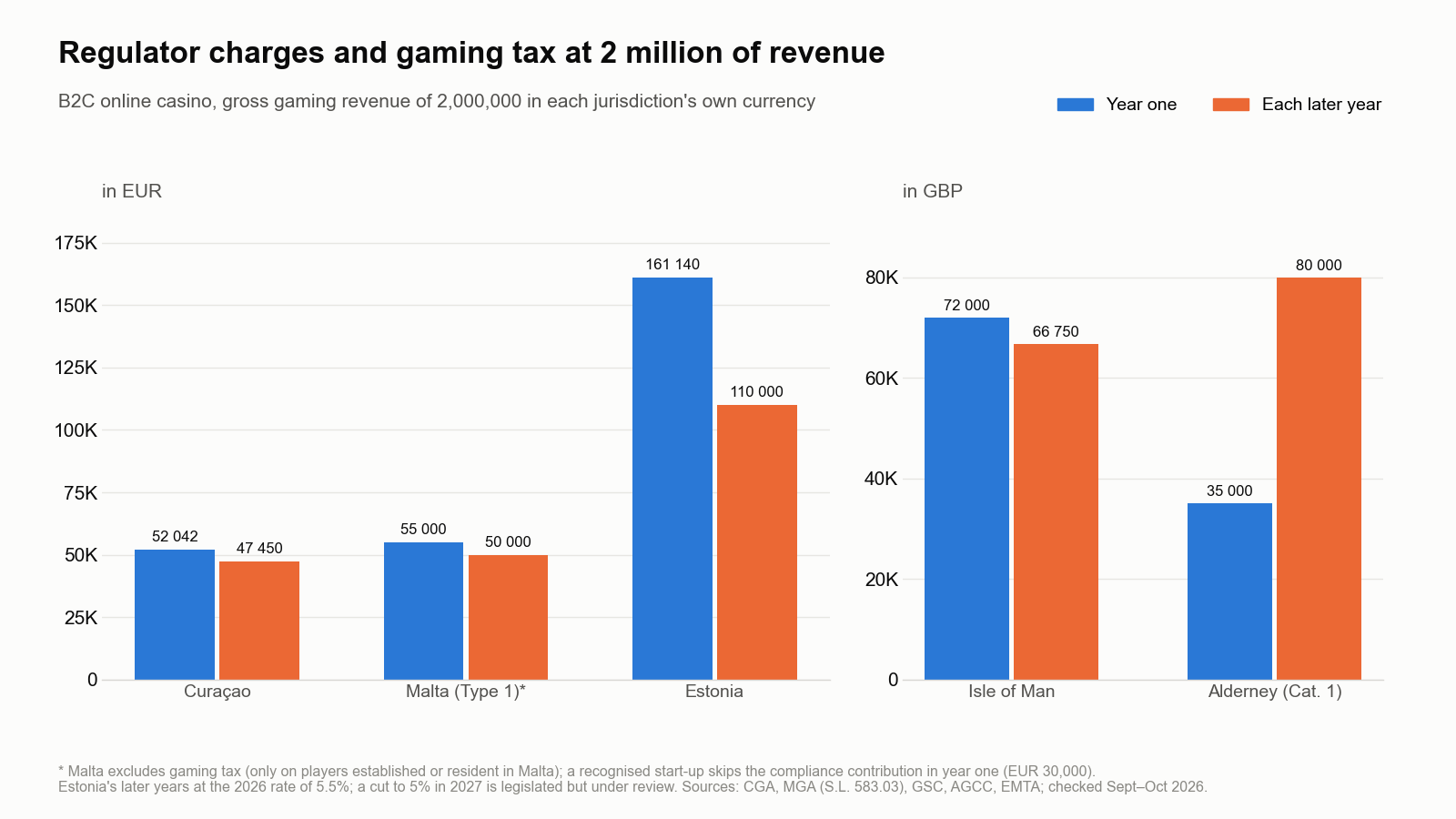
Regulator charges and gaming tax at 2 million of revenue, by currency.
# What the comparison shows
The cheapest entry is not the cheapest year two. Alderney can be entered for GBP 17,500, the lowest first-year charge here. At 2 million of revenue its renewal fee is GBP 80,000, the highest fixed charge in the table if Malta’s gaming tax is set aside. Curaçao works the other way round: its flat EUR 47,450 looks high for a start-up and becomes cheaper in relative terms as revenue grows.
A tax rate means little without its base. Malta’s new 15% rate is charged on revenue from players established or resident in Malta. An operator whose players are elsewhere may pay little or no gaming tax and still owe the EUR 25,000 compliance contribution, which is calculated on all revenue under the licence. Estonia is the opposite case: its licence covers the Estonian market only, and at this revenue the 5.5% tax dominates the total.
Duty that scales with revenue changes the picture at size. On the Isle of Man the 1.5% rate applies up to GBP 20 million of yield, then drops to 0.5% and to 0.1% above GBP 40 million. Malta’s compliance contribution also tapers, from 1.25% down to 0.40% of revenue, and is capped at EUR 375,000 for Type 1.
# The costs the table leaves out
- Capital. Estonia requires share capital of at least EUR 1 million for a games-of-chance licence. Malta requires EUR 100,000 for Type 1 or Type 2 services.
- Substance. A Curaçao licensee must be a local NV or BV managed by a Curaçao resident, employ a full-time key person on the island and keep local premises; new B2C operators below ANG 20 million of gross gaming revenue are exempt from the key-person and premises requirements for three fiscal years. The Isle of Man requires two local directors and a resident designated official.
- Market access. None of these licences covers Great Britain (England, Scotland and Wales), which requires a Gambling Commission licence, and a Maltese licence does not passport across the European Union.
# How to use this for your own numbers
Swap in your own revenue forecast for three years, apply each regime’s banding or rate, and add capital and local staff as separate lines. Then check every figure against the regulator’s own page before filing, because rates move: Malta’s changed on 1 October 2026, and Estonia’s 2026 rate of 5.5% took effect in practice on 1 March 2026 after a drafting gap. The fee and tax comparison maintained by Gambling Law Index lists the source and review date for each number.