You Have a License — But No Market Access: Jurisdiction vs. Right to Operate

# Jurisdiction license vs. market license
Some jurisdictions issue licenses that have nothing to do with where the players are. Curaçao, Malta, Isle of Man, and Alderney typically serve this purpose. Then there are markets that require their own license from anyone accepting their residents. In that second case, what matters is where the player sits — not where the operator is registered.
The UK is the clearest example. Under the Gambling (Licensing and Advertising) Act 2014, any operator serving customers in England, Scotland, or Wales must hold a Gambling Commission license. A Malta, Curaçao, Isle of Man, Alderney, or Estonian license doesn’t substitute for it.
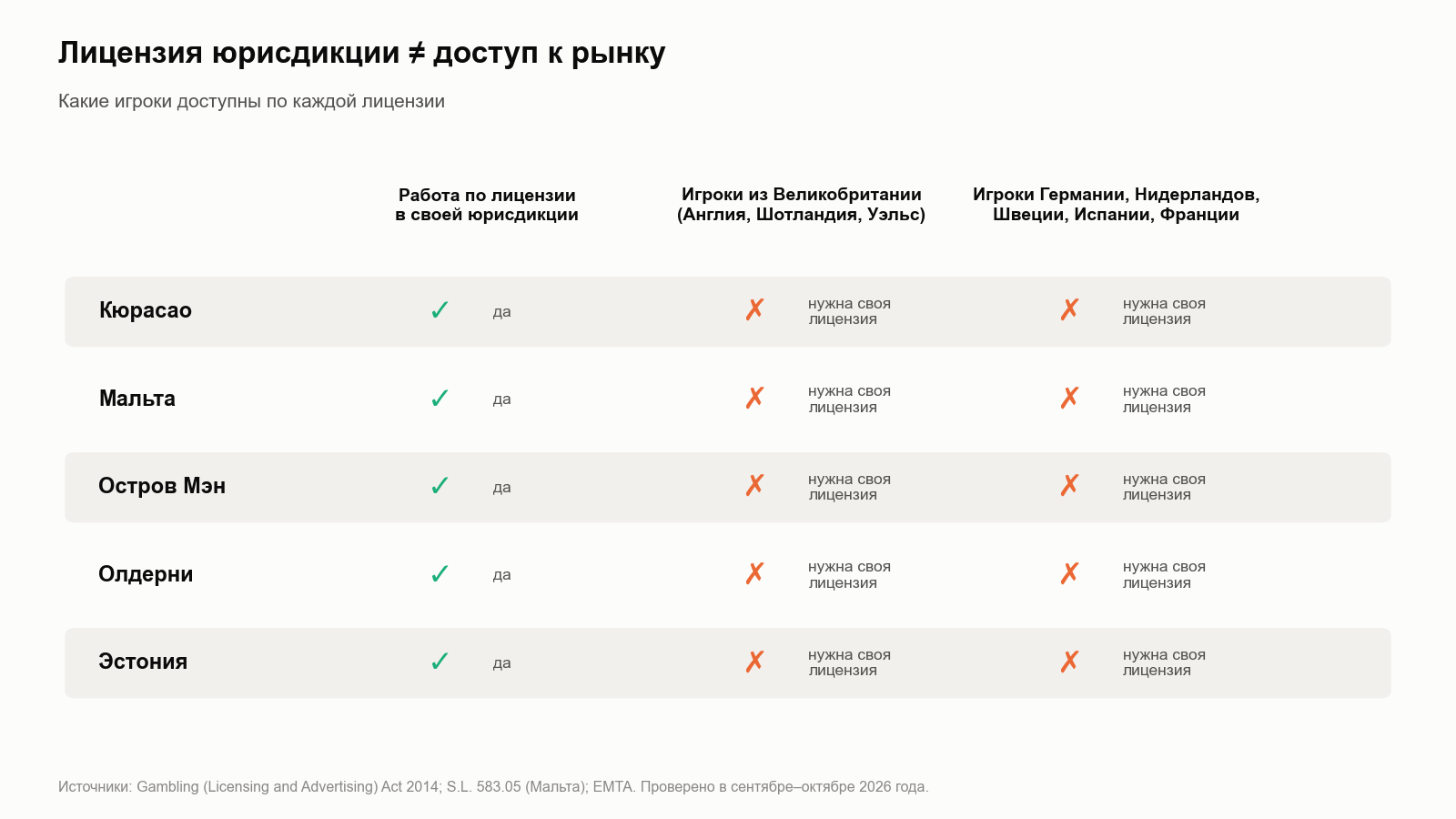
Jurisdiction license vs. market access. Sources: Gambling (Licensing and Advertising) Act 2014, S.L. 583.05, EMTA.
# There’s no single EU license
A Malta Gaming Authority (MGA) license is often read as an “EU license.” It isn’t. It operates within Malta’s regulatory framework only. EU member states license gambling independently, relying on a public-policy exemption under EU law. To serve players in Germany, the Netherlands, Sweden, Spain, or France, you need a license from each of those countries.
Estonia issues a remote gambling license through EMTA (the Estonian Tax and Customs Board), but that permission covers Estonian players only — it doesn’t extend to other EU markets. In Sweden, offering gambling to local players without a Spelinspektionen license is illegal, full stop.
# Some markets aren’t accepting new applicants
Even when you know exactly which license you need, you can’t always get one. Spain issues general gambling licenses only during announced application rounds. The last round ran from December 17, 2017 to December 17, 2018. No new round has been announced since. And the license can’t be sold or transferred to a third party — it only passes during a merger, spin-off, or partial business transfer, and only with approval from regulator DGOJ.
Argentina has no federal gambling license at all. Gambling is regulated by provinces and the City of Buenos Aires — 24 separate licensing bodies. Buenos Aires Province capped online licenses at seven, and all seven were allocated by the end of 2020. A provincial license covers only residents of that province, and licensed sites must operate under a .bet.ar domain.
# How to spot a licensed operator
- Domain. Colombia’s regulator Coljuegos advises players to check that a site’s address ends in
.CO. In Buenos Aires Province and the city, licensed sites run on.bet.ar. In Cyprus, licensed online bookmakers operate under.com.cy. - Regulator’s public registry. Sweden, Cyprus, and Colombia publish lists of their licensees. Estonia goes further and maintains a list of blocked unlicensed sites.
- Product scope. Cyprus’s Class B license covers only electronic sports betting. Online casinos and slot games are off-limits under that license class.
# Operators aren’t the only ones on the hook
Markets also protect themselves through the supply chain. In Romania, companies holding a Class 2 license — which covers platform and software providers, payment processors, and affiliates — cannot serve operators that accept Romanian players without a Class 1 license. They’re required to block access to such operators themselves. Software, platform, and payment providers must report monthly to Romania’s regulator ONJN on blocked players and unlicensed platforms. Any supplier that wants to keep its Romanian license has to vet its clients.
# Three questions before choosing a jurisdiction
- Where do your target players live, and does each of those countries require its own license?
- Is that market currently accepting new applications, or is the number of licenses capped?
- Do your suppliers and payment partners have regulatory obligations toward those countries’ authorities?
Working through those three questions narrows the jurisdiction list faster than comparing fee schedules. A country-by-country map with regulators and primary sources is available at Gambling Law Index. Data in this article was verified against legislation and regulator websites as of September–October 2026.
# See also
- Best Crypto Exchanges for Ukrainians in 2026
- Business Grants in Ukraine 2026
- How to Accept International Payments as a Sole Proprietor in Ukraine
- Banks
- Insurance
- Calculators